
organic search SEO
SEO is about systems...
Systems mean efficiency
Systems mean consistency
Systems mean predictability
It's simple. we know how to rank, without spending a ton.
Why SEO matters and how we are different
Most marketing agencies are middle-men.
They own the customer relationship, but the actual work is done by people like us.
We do all our own SEO in-house.
We build our own blogs, research & create content, and manage ALL the SEO functions ourselves.
We can charge our customers "wholesale" prices because of that.
You get the better service and pay less.
You need marketing, but at what cost?
The challenge we see with small business owners is time & money.
On the one hand they are busy running their business (no time), and on the other, they can't afford the typical marketing agency fees of 2–3k a month (money).
We step in to solve that problem.
We provide way better pricing AND more effective services.
It's a true win-win.
You want results now...
Unless you have a big Ads budget, I would suggest you curb your expectations.
This is where business owners set themselves up for disappointment.
You can monitor your progress each month, but to think that SEO is going to start working right away is just fantasy.
Manage your expectations and be 'long term greedy', then you will win.
Currently Using a Marketing Agency?
It is rare for marketing agencies to actually provide the value they are charging for.
Most often, there is a perceived value that is being delivered; that is, you got a really nice website, but you are paying $3k a month over and over again for all these other services that you actually aren't getting.
Hence, my call to "fire your marketing agency".
CURIOUS HOW WE DO IT?
Ask Me About Our Risk Free Offer...
OUR SEO SERVICES
The 5 Core Components Of SEO Let's Understand What Good SEO Is...
The chart below categorizes each component, below that, we have summarized briefly what each of these components actually is, and how they effect the whole. SEO is truly a 'whole is greater than the sum of it's parts" type of thing. You can be strong in one of the components yet weak in another, and that will have an adverse affect on your results. Hence, having a system in place becomes so important. There are so many moving parts to SEO. At last count, Google's list of ranking factors was more than 200.
On-Page SEO
Keyword Research
Content Optimization
Meta Tags
Improving User Experience
Off-Page SEO
Link Building
Social Media Marketing
Influencer Outreach
Technical SEO
Website Speed
Website Security
Crawlability
Local SEO
Google My Business Optimization
Local Citations
Gathering Positive Reviews
Content Creation
Engaging Content
Informative Articles
Blog Posts
Highlights Of Our SEO Process
We then take these processes and duplicate them to rank our clients for keywords in surrounding cities such as Beverly Hills, Orange County, West Hollywood, Hollywood, and beyond...
On-Page SEO
On-Page SEO refers to all the technical, and some non-technical factors that occur on the actual webpage. So for example, google reads not just the content of your pages, but also things like Title Tags & Meta Descriptions. These are important components to 'signal' to google that your page is relevant for the search query being performed. Next, there is the actual content and its quality; does the content inform the reader about all the aspects of the subject? Are there supporting hyper-links where the reader can learn more? Does the page have structured data? Structured data is one of the most overlooked features of on-page SEO and it's also the most commonly overlooked. We have a process for each and every page we create; from service pages to location pages. We are mindful of how to expand the subject business service area while making it easy for google to understand what the site is about and capturing as many relevant keywords as possible.
Title Tags– DON'T just stuff keywords in, be natural but DO use your primary KW
Meta Descriptions– Concise summary of what's on your page, use long tail KW
Schema– GET YOUR SCHEMA DONE RIGHT!
You can learn more about schema HERE. Moreover, if you're looking for top notch schema writer, I recommend THIS.
Expertise
Experience
Authoritativeness
Trustworthiness
Google's E.E.A.T
Google has provided us with guidelines as to what it wants to see when it comes to getting ranked. The term we use for that is EEAT. It stands for...
If you really want to go down the Google rabbit hole, you can pour yourself a cup of coffee, or a hundred cups, and go through this... Google's Search Quality Evaluator Guidelines.
Off-Page SEO
Off-Page SEO is also referred to as backlinks. These are links that other sites have pointed to your specific page. For example, if I am writing about Google, and I hyper-link a phrase which, when clicked, goes to google– that is a backlink. It's a vote of confidence, or sign of authority; and when a site accumulates a lot of those, it signals to google that you are an authority in that subject. Below is a great video by one of the top SEO guru's I know on backlinking.
We highly recommend QGP for backlinks. We are not affiliates.
Backlinks matter- a lot
Steer clear of link farms & non-relevant links
Backlink profile should be natural and organic
The sending site's on-page SEO is crucial
Google's Helpful Content & SEO
This one is pretty straightforward. When you are looking for a personal injury attorney, you probably have some other questions. You don't want to land on a website and just see a bunch of 'billboard' style ads asking you to call the office for a 'FREE' consultation. Google wants searchers to STAY on your page– they call it DWELL TIME, and that is a big ranking factor. If someone searches for personal injury and simply comes to your pages and 'bounces' off after a few seconds– Google will actually log that event and your 'Bounce Rate' will be high, which tells Google that your visitors aren't really finding what they are looking for on your site. What's worse, imagine you are a personal injury attorney and a visitor lands on your site through a search query; after a few seconds on your site, they click backwards and go to one of your competitors, and they stay on their site for a few minutes. Well, your competitor just got a big boost in rankings. The aforementioned event signaled to Google that you are indeed like the other site, BUT the other site is actually able to give searchers what they are looking for. Hence, you will not only lose your current rankings, but your competitors will start moving up.
Here are a few key points to remember when it comes to content:
Focus on People First- don't just take what AI gives you. Make it your own...
Avoid thin content- don't just regurgitate what's on the web. Provide insight...
Expertise & Authority- Why should we listen to you? Make yourself the expert...
Interlinking Within Your Website
Interlinking is the process of linking one page of your site to another; this enables the reader to learn more about the particular subject they are interested in. For example, let's say you're a fence building contractor. Your home page will talk about various aspects of your services, the areas you may serve, etc...then at some point you invite the reader to 'learn more' about your vinyl fence installations– so you would provide a clickable link from your home page to a service page, which talks about vinyl fencing installations. It is important not to confuse interlinking with linking out– which is when you link 'out' to a completely different website to reference something or expand on a topic by providing 3rd party support. I have linked out to several other helpful sites from this page; and below, I provide an interlink to our local SEO page, which discusses local seo as opposed to SERP's– which is what this page talks about.
From a more technical perspective, interlinking helps Google understand your site structure, which make your site more 'crawlable', which in turn makes it more understandable for Google bot– remember, it's all an algorithm that Google uses to take all these factors and give you a 'score'. When internal links are used strategically, they help highlight the most critical pages on your site, often referred to as pillar content. These are typically the pages you want to rank highest for your main keywords. By linking to these pages from various other pages on your site, you signal their importance to search engines, and that ultimately translates to better rankings.
Internal linking also plays a crucial role in distributing link equity—or "link juice"—across your website. Link equity is the value passed from one page to another through links, which contributes to the receiving page's ranking potential. When a high-authority page on your site links to another page, it passes some of its ranking power to that page. By strategically placing internal links to pages you want to boost in search rankings, you can funnel authority to those pages, helping them rank higher. This is especially useful for new content that hasn't yet accumulated external backlinks.
For example, if you have a blog post that ranks well and gets a lot of traffic, linking from that post to a product page can help increase the product page's authority and, consequently, its search ranking. Internal links should be contextually relevant, ensuring that they are placed in a way that makes sense for the user and adds value to their experience. Unlike backlinks, which are links pointing to a particular page on another site to your site, interlinking is using the authority from an existing page on your site and passing some of that along to another page on your site.
Backlinks. What are they and why they matter...
Every experienced SEO person uses backlinks. The question is whether they are using them the right way...
A backlink is simply a mention or hyperlink from one website to another. However, from an SEO perspective, Google sees and evaluates backlinks as a potential vote of confidence so to speak. For example, let's say you're a cardiologist and your website contains informative content about the latest cardiac surgical procedures. If WebMD wrote an article about some of the content on your website and then cited that content, that is a huge vote of confidence to your site. Google will recognize your site as an authority on the subject, and over time, your content will start ranking higher in Google.
Our Approach to Link Building...
We don't buy links or use spammy tactics that put your site at risk. Instead, we build backlinks the right way — through strategic outreach, compelling content, and genuine relationship building.
Our link acquisition process includes digital PR campaigns that earn coverage from journalists and bloggers, guest contributions on respected industry publications, resource link building that positions your content as a go-to reference, and competitor backlink analysis to uncover opportunities they've already validated. Beyond that, for particular industries that we cover, we have built our own blogs and relavent backlink sources which enables us to control how and where we direct that 'power'.
Another important factor in our backlink strategy is that we source CONTEXT relavent backlinks. Many agencies will provide low value links but get a lot of them; or they may find powerful sites to get links from, but those sites are not in the same niche as their clients business– think a law blog linking to a functional medicine website.
The Power of Backlinks:
Why links matter for SEO
Timeline:
1m Plan
3m Links
6m Rank
#1
Ranking Factor
Quality Links:
1 authority = 100 spam
Spam Links:
Risk penalties & lost rank
Our Approach:
Digital PR
Guest Posts
Competitor Analysis
Impact: ↑
DA Authority
+150%
Traffic
Local SEO– Why We're The Best.
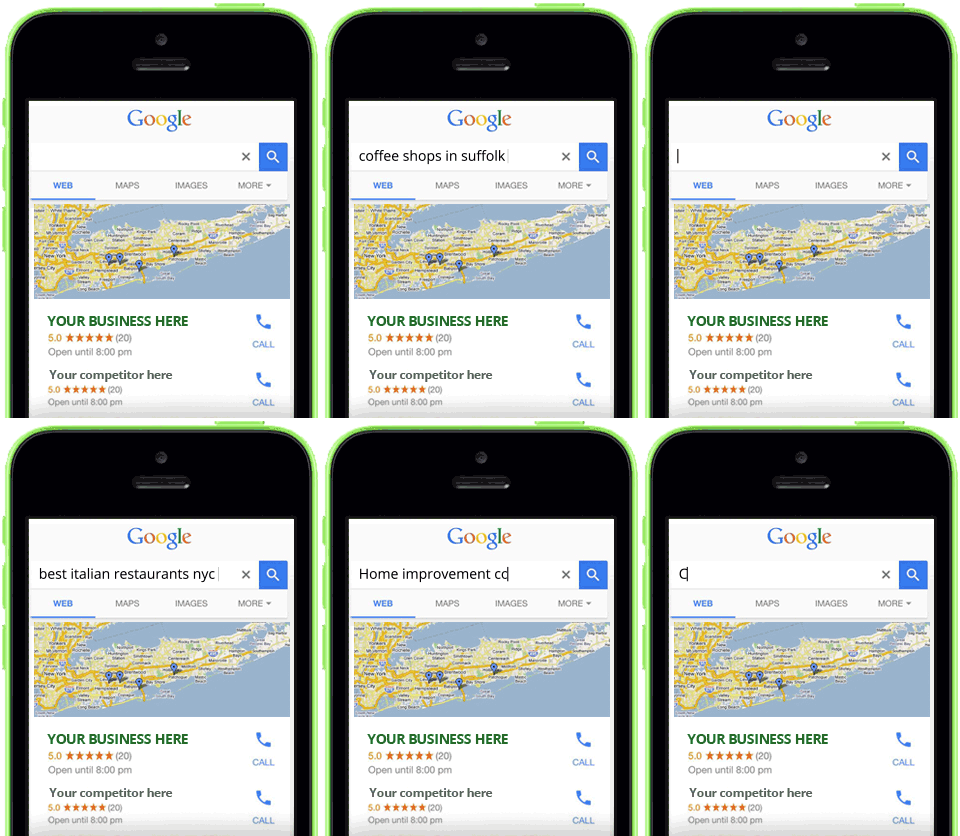
Local businesses NEED seo to get more leads. In particular, they should focus on getting in Google's Map Pack. That is where Google highlights 3 businesses based on the search query. There are many factors that go into who gets in one of those three coveted spots let's take a look at local SEO.

SEO & Automations
Curious how we use automations to help us get SEO results without spending a ton of money?
Transform how you run your business with our all-in-one platform.
We're on a mission to help 100 business owners!


Page Links
Services
Our Location
© Copyright 2026. Tru Path Marketing. | All Rights Reserved.